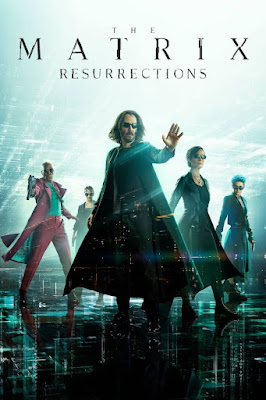
Notable Cast: Keanu Reeves, Carrie-Anne Moss, Yahya
Abdul-Mateen II, Jonathan Groff, Jessica Henwick, Neil Patrick Harris, Jada
Pinkett Smith, Priyanka Chopra, Christina Ricci, Lambert Wilson, Chad Stahelski
There’s a joke somewhere where I sarcastically connect the
term ‘reboot’ between a computer being reset to cleanse itself of running
programs and the idea that this long awaited sequel, The Matrix
Resurrections, serves as both a sequel and a reboot to the series as it
attempts to enter into its next phase of existence. It’s an easy joke to make
and I spent a stupid amount of time sitting in the theater prior to the start
of the movie trying to craft the wording and introduction to this review.
Too bad The Matrix Resurrections beat me to the
punch.
This fourth film in the series, although one might consider
it the fifth since the Wachowskis consider the spin off film, The Animatrix,
as canon in the series, knows exactly what purpose it serves. This is a film
that’s meant to recapture the delights of the original 1999 genre-bending
classic while pushing the franchise into a new age for possible new sequels and
IP creation while feeding into an audience’s nostalgia. It’s the quintessential
reboot. That’s the definition. That’s what a reboot is and does.
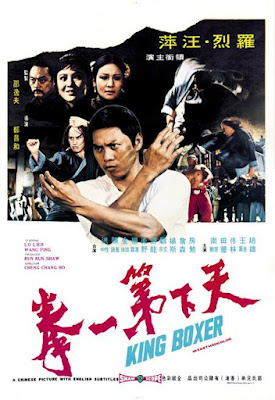
King Boxer, or as it may be more widely known in the
US as Five Fingers of Death, is such a seminal kung fu film in the
history of cinema that it absolutely had to be the first film featured in this
latest boxset from Arrow Video, Shawscope Vol. 1. Now I won’t review the
film in whole here, as I have said what I had to say over in an article on the
impact and strength of the film at the 36 Styles website (link below for those
interested), but I did want to make mention that it’s one hell of a way to kick
off a box set.
Not only is this the best the film has looked in release in
the US, although my Dragon Dynasty DVD certainly holds up, but it has a ton of
fantastic features worth mentioning. In particular, the Tony Rayns commentary
about the history of the Shaw Brothers studio as it led up to the release of King
Boxer - including a fantastic discussion on its director, is one of the
highlights of the entire box set.
It also features a slick little documentary about the Shaw
Brothers studio, the first of three parts, that covers a ton of ground and is a
nice feature to add to the mix. A plethora of interviews, alternative titles to
feature the US titles, and commentary by David Desser cap off the features and
all of them are worth the examination if you are cinephile - and not just ones
interested in kung fu.
As mentioned, if you want to read my full review of the
film, please visit the 36 Styles website here:
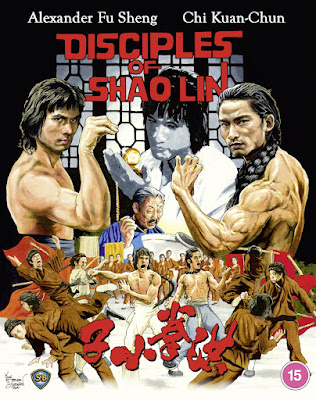
Notable Cast: Alexander Fu Sheng, Chi Kuan-Chun, Chen
Ming-Li, Wang Ching-Ping, Lu Ti, Chiang Tao, Fung Hak-On
There are an epic amount of kung fu movies that start off
with a demonstration of the martial arts that will be shown in the upcoming
film, performed in front of a starkly colored backdrop. It’s a commonplace
occurrence in many of these films, particularly from a specific time period,
that fans of the studio’s output will be familiar with.
With Disciples of Shaolin, there is a specific tone
to how the film starts in this style. The bright yellow background allows a
shirtless Alexander Fu Sheng to pop, as he runs through a series of kung fu
movements. There is no score. The sound of the metal rings on his arms clank
and jingle. His face is dour and intense. He moves to practice on a set of Shaolin
poles as a soundtrack finally sneaks in for the last portion.
This routine carries on for almost five minutes before the
film leaps into its main story, following a bullheaded and cocky young fighter,
played by Alexander Fu Sheng, as he attempts to make a name for himself on the
hard streets while befriending another mysterious fighter played by Chi
Kuan-Chun.
Notable Cast: Bian Jiang, Cai Haiting, Su Shangqing, Zhang Lei, Zhang He, Lin
Qiang, Liu Sicen, Wang Chenguang, Song Ming, Feng Sheng, Zhang Yaohan, Bai
Xuecen, Qiu Qiu
At this point and time, with the boom of the Chinese film
industry still refusing to slow down, bolstered by the emergence of new avenues
like straight-to-streaming and animation studios, it’s always good to know that
there will now be an exponential amount of Monkey King movies to flood
my viewing queue. I mean, there was already an entire industries’ worth that
has already been released, but now there are further avenues to make even
more.
Yay.
The latest is the animated feature, The Monkey King
Reborn, which is granted a very gracious US release via our friends over at
Well Go USA on both DVD and Blu Ray. It’s not the first animated feature of the
Monkey King to drop in the US, although I’d be hard pressed to find anyone that
remembers Monkey King: Hero Is Back from five or six years ago (even
with Jackie Chan voicing Wukong in the English dub). And, quite frankly, Monkey
King Reborn may not quite find its American audience either.
Notable Cast: Keri Russell, Jesse Plemons, Jeremy Thomas,
Graham Greene, Scott Haze, Rory Cochrane, Amy Madigan, Cody Davis, Sawyer
Jones, Arlo Hajdu
Back in early 2018, Guillermo del Toro made a phenomenal
speech after winning the Golden Globe for Best Director. He spoke about how his
dedication to telling stories about monsters was driven by their meaning beyond
scares and fear and how their representation of our flaws as the human race
made them incredibly provocative and meaningful.
With a speech like that, it’s not shocking that most of the
films he produces, even when wavering in quality, tend to aim for that same
layered storytelling. That’s why when it was announced he would be producing
the Scott Cooper-directed horror film, Antlers, it was hard not to get
excited. Unfortunately, a pandemic and some studio delays made sure that the
film didn’t get released until the latter part of 2021 for the Halloween
season, but strong trailers and an interesting combination between producer and
director crafted one of the most hyped films of the year.
Unsurprisingly, I suppose, audiences and critics panned the
film.
Antlers does represent an intriguing mixture of
balancing and tones underneath a film that is both perhaps too mainstream for
the A24 crowd and too vaguely layered in its offbeat artistic choices for the
mainstream crowd. It walks an achingly wound tightrope of expectations and the
results were going to disappoint at least one of the two sides of the audience
it was aiming for. However, Antlers is hardly the tragic misfire of
talents that so many of its critics and fans claimed it to be. While it does
make a variety of perplexing decisions with its material, there is such a
daunting and haunting undercurrent of its themes that deserves far more credit
than it was given.
As the film follows its main characters, led by schoolmarm
Julia and her local sheriff brother Paul, it does play itself on two levels.
The surface level is the classic “nature fighting back against the grievances
of man” where a Wendigo is unleashed upon a small town in Oregon due to the
results of over-foresting and mining. Julia, played with the now natural
ability of Keri Russell to feign confidence and capability over a traumatic
character’s past - mostly likely refined by her stint on The Americans, starts
to investigate a young boy in her class who she sees signs of domestic abuse.
It doesn’t take long to escalate as the Wendigo the young boy is trying to keep
at bay, releases its fury at people in the small community.
For this level, Antlers hammers into the formulas of
the creature feature in some interesting ways. The film avoids showing the
ravages of the incidents on the town as a whole, avoiding some of the cliches
of the townsfolk up in arms about murders or disappearances, and instead
focuses on the tale of the two main families - that of Julia and her brother
and the young boy tormented by the Wendigo. Cooper cakes the film an
atmospheric visual fog, utilizing impressive cinematography to create a
fairytale-like tonality to this story. The performances are impressive enough
between its three leads - strongly using Jesse Plemons to balance out Keri
Russell in a thematic way (more on that in a second) and benefiting from a
screen stealing performance from Jeremy Thomas as the young boy, Lucas,
which garners an uneasy relationship with film’s viewers in his blank, vaguely
sad eye acting and emaciated physical performance.
It’s ultimately an intimate film in how it approaches its
story, something that doesn’t necessarily lean on the spectacle of its monster
that people might have been expecting, and it tends to leave a lot of its
backstories and explanations vague and subtle. At times this can be
frustrating, particularly how the film leans heavily away from the Native
American roots of its creature and only brushes by those in a way that feels
like it might have been a studio note on the script, rather than a fully
realized thematic element. Yet, it’s hard for me not to buy into the larger
choices that Cooper is making for its narrative and the overall creature
feature of its surface story. It’s enough to capture my attention with some
strong visuals and entertaining horror sequences that build on the accumulating
dread of its mysteries around the Wendigo.
Yet, it’s the thematic elements and allegories that are the
reason Antlers hung with me long after its credits had rolled by. It
should be notable that the film brushes along a slew of various themes from the
previously mentioned resource mismanagement or the Native American lore, but it
also touches on a couple of key ones with the human condition like alcoholism
or addiction and the circular cycle of domestic violence. It’s in these latter
themes that Antlers thrives. The manner that it ties these thematic
ideas into the Wendigo lore and how the characters interact lifts the film
above the usual creature feature material. There’s a lot to chew on in these portions
and it’s worth noting for its layered approach to the material.
Perhaps Antlers was just a film that could not live
up to its own hype created by its strong marketing and balancing act between
cinematic approaches. At least in the public’s eye. Its allegories are layered in multiple ways and its tale of a creature is far more concerned with its themes than consistency in narrative. That’s the trick of the
film, ultimately. Its unique choices and bold topics are not necessarily in the
best balance, but it's through those choices that Antlers finds its
voice - in between the styles and in between the tones.
After grossing an insane amount of money and making it one
of the biggest box office horror franchises of all time, Sony wasn’t going to
take long to reboot the Resident Evil franchise. It’s not like Sony has
a lot of load-bearing franchises to begin with under their belt and letting
this one stay dormant for too long would be asinine.
To their benefit, this reboot of the long-running video game
series does go back to the source material roots and away from the Matrix-knock-off
action meets the inescapable silliness of Paul WS Anderson throwing random shit
at his audience. Resident Evil: Welcome to Raccoon City, while still
sporting one of the worst titles I can think of in recent history, is a
fantastic idea on paper. Go back to the horror. Go back to the much-loved
characters. Go back to the fear that the Resident Evil game series used
to launch an entire subgenre of gaming.
It’s a shame that Resident Evil - I refuse to use its
full title from this point on - is a middling effort.
Notable Cast: Andy Lau, Sean Lau, Ni Ni, Philip Keung
After the first Shock Wave blew me away (I apologize)
with its blend of tension, thrills, and weirdly effective emotional weight,
waiting for sequel, Shock Wave 2, to finally receive a release in the
United States was a bit of torture, a burning fuse that just kept burning and
never reaching its end (I apologize again). After being released in 2020 to
some decent box office numbers and word of mouth in China, the lack of interest
in releasing the internationally well-regarded sequel - with significant star power
behind and in front of the camera - didn’t bode well for its quality. Was Shock
Wave 2 just aftershocks to the big shock of its predecessor? I won’t
apologize for that joke. Nope.
Notable Cast: Gemma Chan, Richard Madden, Kumail
Nanjiani, Lia McHugh, Brian Tyree Henry, Lauren Ridloff, Barry Keoghan, Ma
Dong-seok, Kit Harington, Salma Hayek, Angelina Jolie, Bill Skarsgard, Harish
Patel
Disney and Marvel have always been very particular with how
they expand the Marvel Cinematic Universe. The introduction of mysticism was in
a wholly generic and formulaic origin film with Doctor Strange, the leap
with Thor into the cosmos happens mostly on Earth, and the introduction
of the multi-verse took two entire Avengers films to pull off. The
latter is a choice that will now seemingly dominate the entirety of the
franchise for the foreseeable future and allow for MCU to exist until mankind
burns to the ground.
For Eternals, a full-on expansion of the MCU into epic cosmos insanity, Marvel and Academy Award-winning director Chloe
Zhao attempt to ride that fine balance once again by introducing an entire new
squad of Space Avengers. They are not the Guardians, for the record, but they
do ask the hard questions to each other like “who will lead the Avengers now?”
to make sure we don’t forget the film is part of the franchise, I guess. These
Eternals have been patiently waiting on Earth to receive the call from Space
Dad, a six-eyed stone-looking red space god named Arishem, to go back home.
Naturally, not all is what it seems and the Eternals’ natural enemy,
animal-like bundles of tendrils named Deviants, arise on Earth once more as a
pending disaster looms on the horizon.
Notable Cast: Fengbin Mu, Yilin Hao, Qihang Zhao, Qiyu
Yang
The pandemic changed a lot of things in the film industry.
At this point, discussion about the box office and the explosive expansion of
streaming services are well-known discussion topics. To be fully honest, I’m a
bit tired of talking about the birth of streaming, the death of ‘cinema’, and
whether or not films that are released straight to a streaming service count as
TV movies or Movie movies. I can only get into so many fights on social media
before it ceases to be interesting. Let’s not forget though, that this change
is happening all over the world.
Case in point, The Emperor’s Sword was released to
the Chinese streaming service Youku was picked up for distribution in the US
via Well Go USA where it received its premiere on their streaming services, Hi
Yah, before receiving a full-fledged Blu Ray release. It’s not the first film
of this ilk to receive this kind of treatment and, yes, there is a cheaper look
to the film and budgetary restraints that tend to limit the film’s tonality and
approach, but The Emperor’s Sword is a much better film than expected.
Perhaps I was just craving a newer wuxia film that doesn’t bombard its audience
with bullshit CGI monsters and wanna-be Hollywood blockbuster spectacle, but
there is a simplicity and classic tone to the core of this flick that hit me
just right.
After unleashing the Daimajin on collectors with
their three-film box set only a handful of months ago, Arrow Video continues
their Daiei run with the Yokai Monsters Collection. Complete with the
original three film run of the Yokai Monster trilogy and auteur director
Takashi Miike’s love letter to those films, this collection brings together
four films that were not regularly available (if at all) to Western audiences.
Whether you’re a fan of supernatural monster flicks, strange genre-bending
slices of cinema, or Japanese film history, it’s hard to go wrong with this
boxset as a collector.
The mileage that one gets from the films included in Yokai
Monsters depends on their ability to roll with the shifting genres and a
sense of artifice within their stories. This review covers the third film in
the series, Along with Ghosts, but stay tuned for more reviews for the
rest of the series.
After bouncing through the second film of the series, Spook
Warfare, with all of its comedic elements and humorous and heartfelt yokai
monster chemistry, the third film Along with Ghosts causes some
significant whiplash. While all three films lean into the period set
horror-tinged supernatural basics, this third and last (of this original run)
of the series finds itself as the most cohesive and cinematically sound in its
storytelling. It may not feature nearly as many yokai as the previous entry -
or, quite honestly, as the first film, but it makes up for it by being a better
film.